ELISA
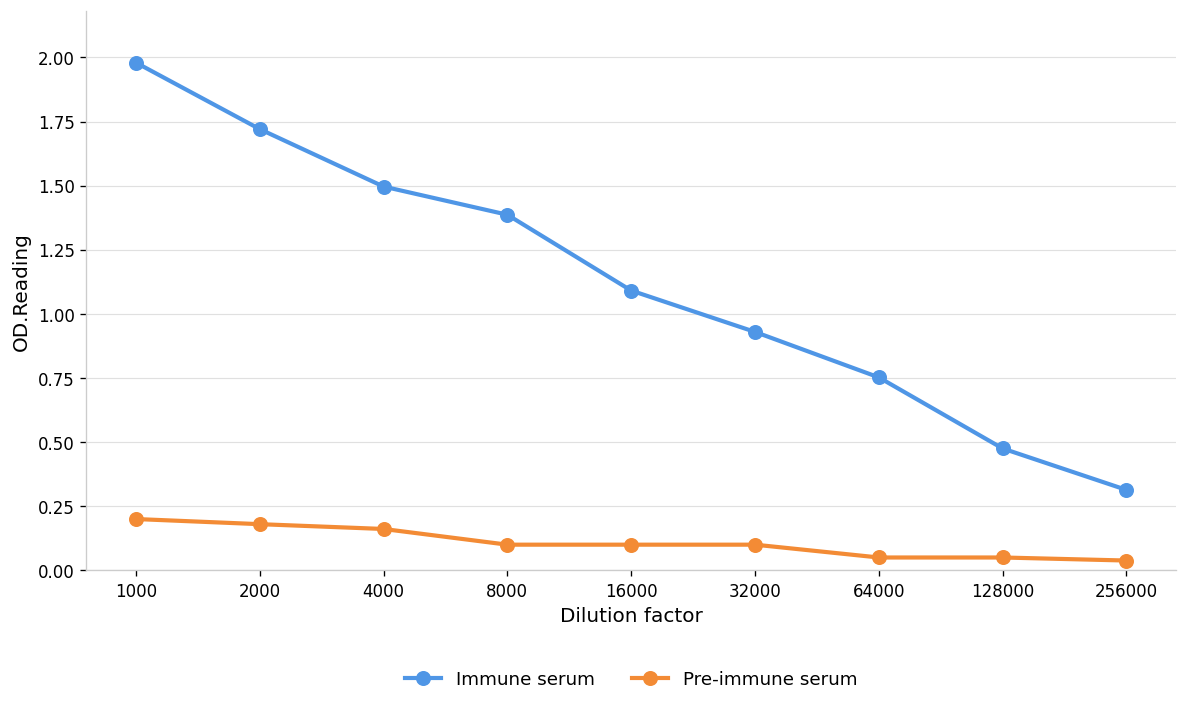
Coat the plate with immunizing antigen.Blue line: Immune serum; Orange line: Pre-immune serum.| Product Name | Anti-MDA5 antibody |
|---|---|
| Antibody Type | Primary Antibodies |
| Immunogen | Polypeptide |
| Clonality | Polyclonal |
|---|---|
| Isotype | IgG |
| Host Species | Rabbit |
| Tested Applications | ELISA |
| ELISA:1:1000-1:10000 |
|
| Species Reactivity | HumanMouseRat |
| Concentration | 1mg/ml |
| Purification | Protein A |
| Gene Symbol | IFIH1 |
|---|---|
| Gene Synonyms | 9130009C22Rik AGS7 Helicard Hlcd IDDM19 IMD95 MDA-5 MDA5 RGD1560496 RLR-2 SGMRT1 |
| Gene Full Name | interferon induced with helicase C domain 1 |
| Gene Summary | IFIH1 encodes MDA5 which is an intracellular sensor of viral RNA that triggers the innate immune response. Sensing RNA length and secondary structure, MDA5 binds dsRNA oligonucleotides with a modified DExD/H-box helicase core and a C-terminal domain, thus leading to a proinflammatory response that includes interferons. It has been shown that Coronaviruses (CoVs) as well as various other virus families, are capable of evading the MDA5-dependent interferon response, thus impeding the activation of the innate immune response to infection. MDA5 has also been shown to play an important role in enhancing natural killer cell function in malaria infection. In addition to its protective role in antiviral responses, MDA5 has been implicated in autoimmune and autoinflammatory diseases such as type 1 diabetes, systemic lupus erythematosus, and Aicardi-Goutieres syndrome[provided by RefSeq, Jul 2020] |
| Alternative Names | CADM-140 autoantigen clinically amyopathic dermatomyositis autoantigen 140 kDa DEAD/H (Asp-Glu-Ala-Asp/His) box polypeptide helicard helicase helicase with 2 CARD domains interferon induced with helicase C domain protein 1 melanoma differentiation-associated gene 5 melanoma differentiation-associated protein 5 MGC133047 murabutide down-regulated protein RIG-I-like receptor 2 RNA helicase RNA helicase-DEAD box protein 116 RNA helicase MDA-5 RNA-dependent ATPase |
| Molecular Weight(MW) | 116kDa |
| Source | Rabbit |
| Cellular Localization | Cytoplasm;Nucleus;Mitochondrion |
| SwissProt ID | Q9BYX4 |
|---|
ELISA
Coat the plate with immunizing antigen.Blue line: Immune serum; Orange line: Pre-immune serum.| Application Notes | ELISA:1:1000-1:10000 |
|---|
| Form | Liquid |
|---|---|
| Storage Instructions | Shipped at 4°C. Store at +4°C short term (1-2 weeks). Store at -20°C long term. Avoid freeze / thaw cycle. |
| Storage Buffer | Purified antibody in PBS with 0.05% PC300,40% Glycerol. |


